Sajjad's kitchen testing note: Many home cooks throw away perfectly good food on day three out of fear, or they leave warm stews sealed tight until condensation sours the entire batch. Food safety is about simple physics and temperature zones.
The 3-to-5 day refrigerator rule
Bacteria multiply rapidly between 40 degrees and 140 degrees Fahrenheit. This temperature range is called the danger zone.
Your refrigerator keeps food below 38 degrees. At that temperature, bacterial reproduction slows to a crawl.
Different foods degrade at different speeds based on moisture and protein content. Delicate cooked seafood lasts three days at most.
Cooked poultry and ground meats stay fresh for four full days. Starchy foods like brown rice, roasted sweet potatoes, and stewed beans stay delicious for five to seven days.
The 2-hour rapid cooling blueprint
The biggest meal prep mistake is taking a boiling pot of stew, snapping on a plastic lid, and immediately putting it on a crowded fridge shelf.
Trapped steam condenses on the underside of the lid. That hot water drips back down, creating a warm, humid incubator that sours food within 36 hours.
Follow this cooling sequence instead:
Cooked food shelf life reference chart
I test my weekly meals against these proven refrigeration timelines:
| Cooked Food Category | Safe Refrigerator Life | Freezer Longevity | Reheat Recommendation |
|---|---|---|---|
| Cooked Poultry (Chicken / Turkey) | 3 to 4 days | 3 months | Reheat to 165 degrees or eat cold |
| Lean Ground Beef or Turkey | 3 to 4 days | 3 months | Hot skillet with splash of broth |
| Cooked Fish & Shrimp | 2 to 3 days | 2 months | Eat by Tuesday night or freeze |
| Hard-Boiled Eggs (In Shell) | 7 days | Do not freeze (turns rubbery) | Peel cold right before eating |
| Cooked Grains (Rice, Quinoa, Farro) | 4 to 5 days | 4 months | Microwave with a splash of water |
| Cooked Legumes (Beans & Lentils) | 5 to 6 days | 6 months | Simmer on stovetop or eat cold |
| Roasted Root Vegetables | 5 days | 3 months | Hot toaster oven or skillet |
| Pureed Vegetable Soups | 5 to 6 days | 6 months | Stovetop simmer in small pot |
Why borosilicate glass beats plastic containers
Plastic takeout tubs look convenient, but they cause major problems for meal preppers.
Plastic is porous. Over time, warm curries and tomato sauces leach into microscopic scratches, creating permanent stains and lingering garlic odors.
Borosilicate glass containers are completely non-porous. You can roast chicken inside the glass dish, let it cool, snap on the lid, and put it directly into your fridge.
Glass containers also distribute heat evenly when you microwave your lunch at work, avoiding cold rubbery spots in the center of your meal.
Three reliable spoilage indicators (and two myths)
You can identify bad food using simple senses.
First indicator: Surface slime. If your cooked chicken or beans feel slick or tacky to the touch, bacteria have formed a biofilm. Discard immediately.
Second indicator: Sour off-gassing. If opening your container releases a sharp, vinegary smell when there is no vinegar in the recipe, lactic bacteria have spoiled the dish.
Third indicator: Color dulling or grey edges. When bright green broccoli turns dull brown-grey and mushy, cellular degradation has taken over.
Myth 1 to ignore: "If it looks fine, it cannot make you sick." Pathogens like Bacillus cereus in day-old rice can produce toxins without changing food odor.
Myth 2 to ignore: "Reboiling spoiled food makes it safe." Boiling kills living bacteria, but it does not destroy heat-stable toxins already produced in spoiled food.
The blue tape labeling system
Never rely on your memory on Thursday morning when you are rushing to work.
Keep a roll of blue painter's masking tape and a black permanent marker in your kitchen silverware drawer.
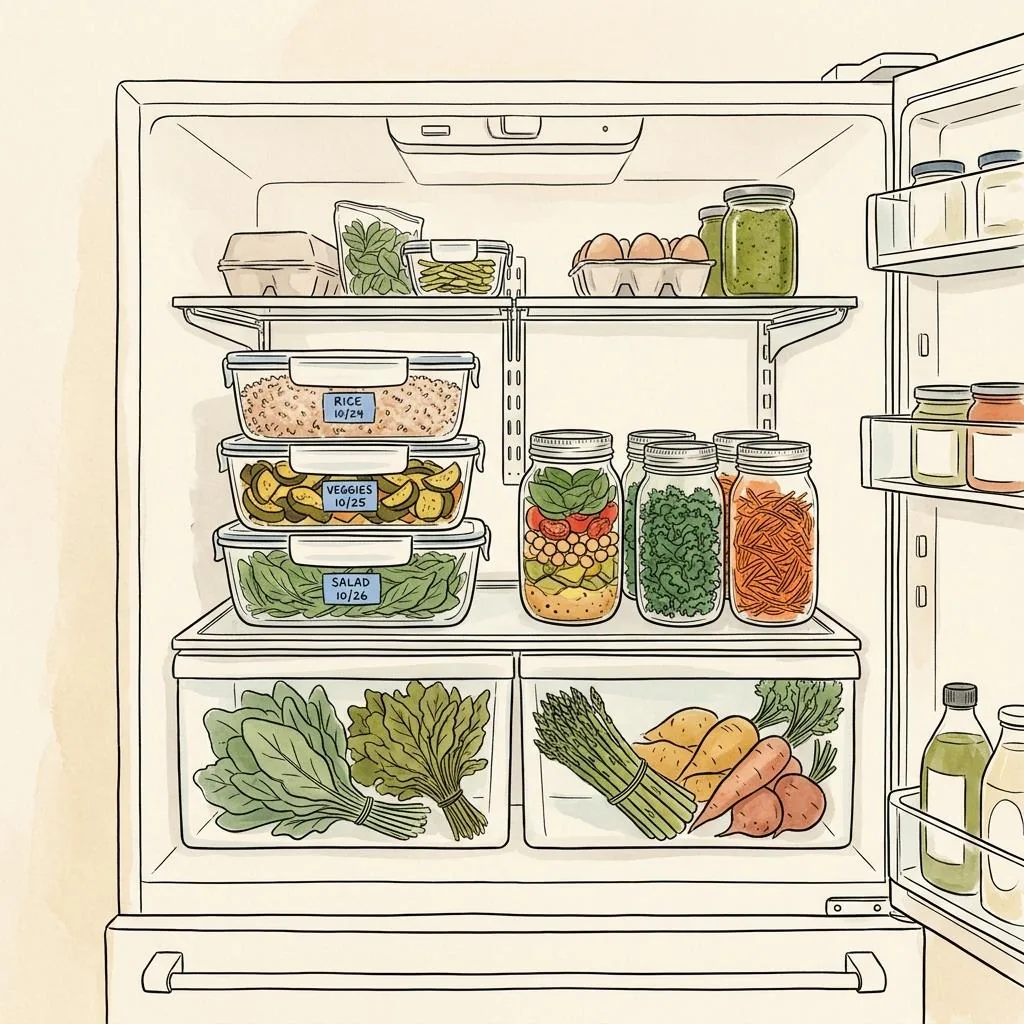
Every time you put a prepped container into your fridge, rip off a piece of tape and write two things: the food name and the prep date (example: "Lemon Chicken, Sun 10/25").
Painter's tape peels off glass cleanly in the dishwasher without leaving sticky adhesive residue. You will know exactly what needs to be eaten first.
Freezer burn prevention: the parchment paper press
Freezer burn is not spoilage. It is dehydration caused by cold, dry freezer air circulating across exposed food surfaces.
When freezing chili, soup, or braised chicken in glass containers, tear off a piece of parchment paper.
Press the parchment paper directly against the surface of the food before putting on the container lid.
The paper creates a barrier that prevents moisture from sublimating into ice crystals on the lid. Your meals taste just as fresh after two months in the freezer as they did on day one.
Frequently asked questions
Can I freeze cooked rice without it turning mushy?
Yes. Spread cooked rice on a baking sheet to cool completely, then freeze it flat in a gallon zip bag. Reheat in a microwave with an ice cube placed on top; the melting steam restores fluffy texture.
Is it safe to put warm glass containers in the refrigerator?
Borosilicate glass handles rapid thermal shifts without shattering. Just make sure the container is warm to the touch, not scalding straight off a 400-degree oven rack.
How many days can pre-washed salad greens stay fresh?
If you line the container with dry paper towels to absorb excess condensation, pre-washed greens stay crisp for nine to twelve days.